
Walton demands answers over Guyana’s own past partnership with the sanctioned IMSAG network
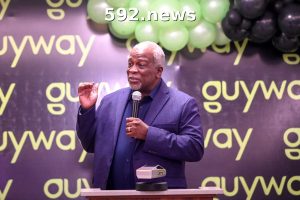
Opposition Member of Parliament Amanza Walton is demanding answers over Guyana’s own past partnership with the IMSAG network, accusing the government of hypocrisy for welcoming United States sanctions against an enterprise it once formally embraced.
In March 2021, the picture from Guyana was one of partnership, investment and opportunity. A report in the state-owned Guyana Chronicle announced a proposed US$35 million joint venture aimed at boosting Guyana’s maritime industry, with plans for a marine training institute, a shipyard and dry dock, 100 scholarships and more than 600 jobs for Guyanese. Photographs showed Indian businessman Captain Suniel Kumar Sharma and associates alongside senior Guyanese officials. The venture was not presented as an outsider operating without government knowledge.
According to the report, Guyana’s Maritime Administration Department, MARAD, had entered into formal arrangements involving Sharma-linked entities. On February 4, 2021, MARAD Director General Captain Stephen Thomas signed an agreement delegating statutory certification services for Guyana-registered vessels. On March 3, MARAD and the Ministry of Public Works entered into a Memorandum of Understanding appointing Sharma’s Aryavart Corporation as an international technical and administrative representative of the Guyana Ships Registry under the name International Maritime Safety Agency of Guyana, IMSAG.
The March 2021 Chronicle report also recorded commitments from Public Works Minister Bishop Juan Edghill, then Minister within the Ministry Deodat Indar, MARAD Director General Thomas and GO-Invest Chief Executive Officer Dr. Peter Ramsaroop to work with the venture.
Five years later, the story looks very different. On November 4, 2026, the United States Department of the Treasury sanctioned Sharma, his wife Jaspreet Preeti Shahid and several associated entities, including Aryavart Ship Management Private Limited, accusing their network of operating fraudulent maritime registries and providing false flags and certifications to vessels transporting Iranian petroleum, including vessels linked to Iran’s military and its proxies.
The following day, MARAD welcomed the United States action. MARAD described Sharma and Shahid as instrumental in managing a network that fraudulently represented vessels as registered in Guyana through IMSAG, and said the government remained committed to preventing fraudulent use of the Guyana flag.
That response has now triggered questions from the opposition about how the same enterprise moved from an officially recognised relationship with Guyanese authorities to what the government now describes as a fraudulent operation.
In an opinion piece titled “From Red Carpet to Rogue Enterprise: The PPP Government must answer for its role in the IMSAG Affair,” Walton argues that the government cannot present itself solely as a defender of Guyana’s maritime registry without accounting for the formal relationship it previously established with Sharma and his companies.
“These are not my allegations,” Walton wrote, noting that details of the agreements were later referenced in correspondence from Guyana’s Attorney General to Sharma.
Her central question is straightforward: if the relationship later proved problematic, what due diligence was carried out before Sharma-linked entities were given authority connected to Guyana’s international ship registry? Walton is also asking who introduced Sharma to the Ministry of Public Works, who approved the arrangements, and when officials first became aware of alleged misconduct. She also wants to know why the termination of the relationship was not immediately announced publicly, and what safeguards were put in place after the authorisation was withdrawn.
Guyana eventually severed the relationship. MARAD has said it terminated all arrangements with IMSAG on August 13, 2021. But that termination became widely visible months later, after the cargo vessel Eolika, reportedly carrying illegal arms and ammunition, was detained in Senegal while purportedly operating under Guyana registration.
On January 20, 2022, MARAD said Eolika was not contained in Guyana’s local ships registry and that its documents were believed to have been issued by IMSAG. Four days later, the Guyana government issued a much stronger statement declaring that it was “in no way connected or related” to IMSAG or its principals. That statement acknowledged what it described as an “undertaking” with MARAD but said the relationship had been halted after fraudulent representations and illicit conduct were discovered. Walton argues that description understated the extent of the earlier official relationship because the Ministry of Public Works itself had been involved in the March 2021 Memorandum of Understanding.
An investigation published by Bellingcat in February 2026 adds important context. The investigative outlet found that IMSAG was not always operating without Guyana’s authorisation.
“Crucial to understanding how IMSAG has continued to operate as a fraudulent registry for so long is that it was once legitimate,” Bellingcat reported. Its investigation found that while the Memorandum of Understanding was in effect, IMSAG served as Guyana’s international ship registry and used the imsag.org domain to register and flag vessels on Guyana’s behalf. Bellingcat said it downloaded 230 vessel certificates covering 87 ships, including certificates issued as recently as December 2025 — long after Guyana withdrew its authorisation.
Sharma has disputed allegations surrounding his current involvement. He previously told the Financial Times that the Guyana registry had been discontinued after authorities withdrew consent, and later told Lloyd’s List that he had left the ship-registration business.
Treasury said the network purported to represent countries ranging from Guyana to Eswatini and Laos and enabled vessels tied to Iran’s shadow fleet to evade international restrictions. It also cited the April 2026 seizure of the Majestic X, formerly the Phonix, which it said was falsely flying Guyana’s flag while carrying Iranian oil. The sanctions target Sharma, Shahid and their entities — not Guyana. MARAD, in welcoming the sanctions, said Guyana had consistently raised fraudulent registration at regional and international maritime forums and supported stronger international action against such schemes.
The unresolved issue is what happened between those points. When did Guyanese officials first discover problems with the operation? What due diligence preceded the February and March 2021 agreements? Who authorised Sharma-linked entities to represent Guyana internationally? Walton says those questions require more than a statement welcoming sanctions. For Guyana, the issue is no longer simply whether IMSAG later used the country’s flag without authorisation. It is also how an enterprise once publicly embraced as a partner of the state obtained that authority in the first place — and whether the full story of that relationship has ever been disclosed.
About The Author