
Venezuela Stirs Up Border Conflict Calling Shooting of Guyana Soldiers “Fake News”
SUBSCRIBE it’s free! Thank you!
LIKE on FACEBOOK Fan Page 👉 https://www.facebook.com/finaltakeaway
FOLLOW on TikTok https://www.tiktok.com/@finaltakeaway
VISIT Channel Page 👉 https://www.youtube.com/@TheFinalTakeaway
MEMBERSHIP: CLICK to JOIN https://www.youtube.com/@TheFinalTakeaway/join
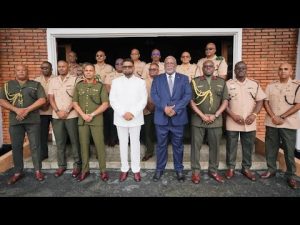
Investigations continue into the shooting incident near the Guyana-Venezuela border as Venezuela is accused of stirring up fresh border conflict. The incident involves soldiers of the Guyana Defence Force (GDF) and alleged members of the notorious Las Claritas Sindicato gang tied to Venezuela. More in the video as new developments unfold on the Guyana-Venezuela border controversy.
Resources:
1. Opposition in Dark about Shooting of GDF Soldiers on Guyana-Venezuela Border- AFC https://demerarawaves.com/2025/02/22/opposition-in-dark-about-shooting-of-gdf-soldiers-on-guyana-venezuela-border-afc/
2. The Minister of Foreign Affairs and International Cooperation summoned the Ambassador of Venezuela to Guyana https://guyanaembassydc.org/the-minister-of-foreign-affairs-and-international-cooperation-summoned-the-ambassador-of-the-bolivarian-republic-of-venezuela-to-guyana-to-condemn-and-demand-redress-for-armed-attack-on-a-gdf-supply-v/
3. Venezuela Denounces Guyana ‘False Narrative’ Over Clash in Disputed Essequibo Territory https://venezuelanalysis.com/news/venezuela-denounces-guyana-false-narrative-over-clash-in-disputed-essequibo-territory/
4. Guyana says 6 soldiers injured in a suspected gang attack on the Venezuela border https://apnews.com/article/guyana-soldiers-deaths-border-dispute-venezuela-887cf9bde2dafc6b9a8ba7e42ed1bd33
5. CARICOM condemns shooting of Guyanese soldiers on border with Venezuela https://demerarawaves.com/2025/02/28/caricom-condemns-shooting-of-guyanese-soldiers-on-border-with-venezuela/
source
About The Author

Thank you for SUBSCRIBING and sharing your views. 🎉🎉🙏Hit the notification bell 🔔to stay tuned for more updates.
We value your feedback and comments. Be reminded that ONLY comments that meet our channel guidelines/policy will be shown below the video. Best wishes!
🇨🇴🇪🇨🎉
None of them still don't have what it takes to make the who it may concern visual representation locally known as worship stimuli public policy .
shut up and take your pills!
"### The Esequibo Region Belongs to Venezuela – A Historical, Legal, and Geopolitical Analysis
The **Esequibo Region**, a territory of 159,542 km² west of the Esequibo River, is the subject of a territorial dispute between Venezuela and Guyana. This resource-rich region was usurped by the United Kingdom through the **Paris Arbitral Award of 1899**, a ruling that Venezuela considers null and void. Throughout history, the maps drawn by Robert Hermann Schomburgk and British actions have shown contradictions and expansionist ambitions that violated historical agreements such as the Treaty of Münster (1648). This document aims to demonstrate that the Esequibo Region legitimately belongs to Venezuela, based on historical, legal, and geopolitical arguments.
—
## *1. Historical Arguments*
### *1.1. Original Belonging to the Spanish Empire*
– The Esequibo Region was part of the *Captaincy General of Venezuela* since its creation in 1777.
– After independence in 1811 and the dissolution of Gran Colombia in 1830, the Esequibo River remained recognized as the natural border between Venezuela and Dutch Guiana (current Guyana).
### *1.2. Treaty of Münster (1648)*
– Spain recognized Dutch settlements east of the Esequibo River, while territories west of the river remained under Spanish sovereignty.
– Subsequent British occupation violated this agreement by expanding its claims westward after acquiring Dutch Guiana in 1814.
### *1.3. British Ambitions and Gold Discovery*
– In the 19th century, gold discoveries in the Yuruari River basin awakened British interest in expanding territorial control.
– This expansion culminated in the arbitrary tracing of the "Schomburgk Line" in 1840, which far exceeded historically recognized boundaries.
—
## *2. British Usurpation and Arbitral Award Contradictions*
### *2.1. The Schomburgk Line*
– Robert Hermann Schomburgk drew several maps between 1835 and 1844:
– His first map (1835) recognized the Esequibo River as a natural border, except for a small "bite" in the northeast.
– Subsequently, he arbitrarily expanded British claims westward, including areas of Cuyuní and Yuruari.
– These contradictions reflect a deliberate act of territorial expansion without legal or historical basis.
### *2.2. The Paris Arbitral Award (1899)*
– The ruling granted Great Britain all territory west of the Esequibo River without valid justification.
– Venezuela denounced in 1962 that the arbitral tribunal was tainted by irregularities, including secret agreements between Russia (arbitrator) and Great Britain.
– The Geneva Agreement (1966) acknowledged this complaint and established a framework for peaceful dispute resolution.
—
## *3. Legal Arguments*
### *3.1. The Geneva Agreement (1966)*
– Signed between Venezuela and the United Kingdom (representing Guyana), this agreement explicitly recognizes Venezuela's position that the Arbitral Award is null and void.
– Establishes mechanisms for finding a practical and peaceful solution to the dispute.
### *3.2. International Law*
– According to international law principles, an arbitral ruling tainted by irregularities is null.
– Guyana inherited a territory usurped by Great Britain but does not have legitimate rights over it.
—
## *4. Geopolitical and Economic Importance*
### *4.1. Natural Resources*
– The region is rich in gold, diamonds, bauxite, and oil.
– Recent offshore oil explorations have intensified the territorial dispute.
### *4.2. Strategic Projection*
– Controlling the Esequibo Region allows direct access to the Atlantic Ocean, with significant geopolitical implications for both countries.
—
## *5. Conclusion*
The Esequibo Region legitimately belongs to Venezuela for historical, legal, and geopolitical reasons:
1. It was an integral part of the Captaincy General of Venezuela since 1777.
2. Initial maps recognized the Esequibo River as a natural border until British expansionist ambitions.
3. The 1899 Arbitral Award was tainted by irregularities and denounced as null through the Geneva Agreement.
Venezuela must continue defending its sovereignty over this territory through peaceful mechanisms established in international law and reinforce its historical position with compelling documentary evidence before international bodies such as the International Court of Justice (ICJ)."